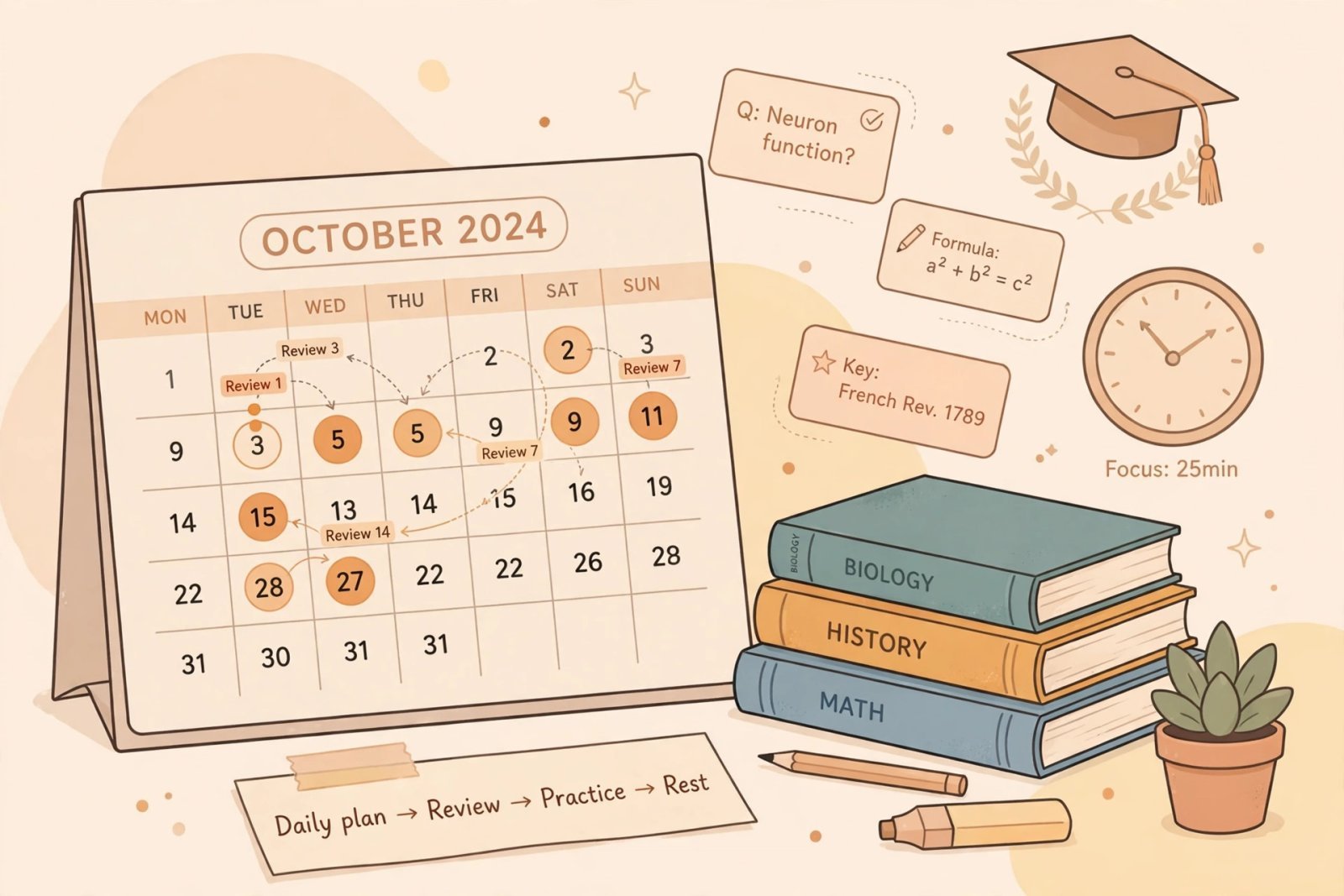
Spaced Repetition Study Calendar for Final Exam Prep
Build a spaced repetition calendar that schedules reviews at growing intervals so exam material sticks long after the first read.

Customize this prompt
Fill in the fields below — the prompt text updates automatically. [BRACKETED] words are placeholders you replace.
The prompt
You are a study coach designing a spaced repetition calendar for a student preparing for [EXAM_NAME] on [EXAM_DATE]. The student must master [SUBJECT_LIST] and currently feels weakest in [WEAK_TOPICS]. Create a review calendar that starts on [START_DATE] and spaces each topic at increasing intervals of roughly 1, 3, 7, 14, and 30 days, with shorter re-checks for any topic the student rates below [CONFIDENCE_THRESHOLD] out of 10. For every review session, state the topic, the exact recall task (for example, blank-page summary or flashcards), and the time budget in minutes, keeping total daily review under [DAILY_MINUTES] minutes. Include a simple tracking table where the student records a confidence score after each session, and rules for pulling a failing topic back to a daily slot until it recovers. End with a final-week plan that drops new material and only revisits the lowest-scoring topics.
How to use it
- List every topic for the exam and rate current confidence from 1 to 10.
- Assign first reviews one day after first study, then at 3, 7, 14 and 30 days.
- Write a concrete recall task and minute budget for each session.
- Add a tracking table for confidence scores after every review.
- Move any topic scoring below the threshold back to a daily slot.
- Use the final week only for the lowest-scoring topics, no new material.
Customization tips
Change the interval ladder for a shorter runway, and swap the recall tasks for flashcards, practice questions or teaching the topic aloud.
Example use case
Students revising for finals, certification exams or professional qualifications who want reviews scheduled instead of crammed.
Frequently asked questions
What if I start too late for the full 30-day spacing?
Compress the intervals to 1, 2, 4, 7 and 14 days and cut the topic list to the highest-weight material first. Shorter spacing still beats cramming everything the night before.
How do I know a topic is actually learned, not just recognised?
Test yourself from a blank page without notes. If you can explain the topic in your own words and answer a practice question, it counts; recognising it in your notes does not.
Share
Tags: study planning spaced repetition exam revision memory techniques study schedule student productivity
Reviewed by the PromptVault editorial team on November 4, 2026.
Source notes: Daily pipeline 20261104 batch 11