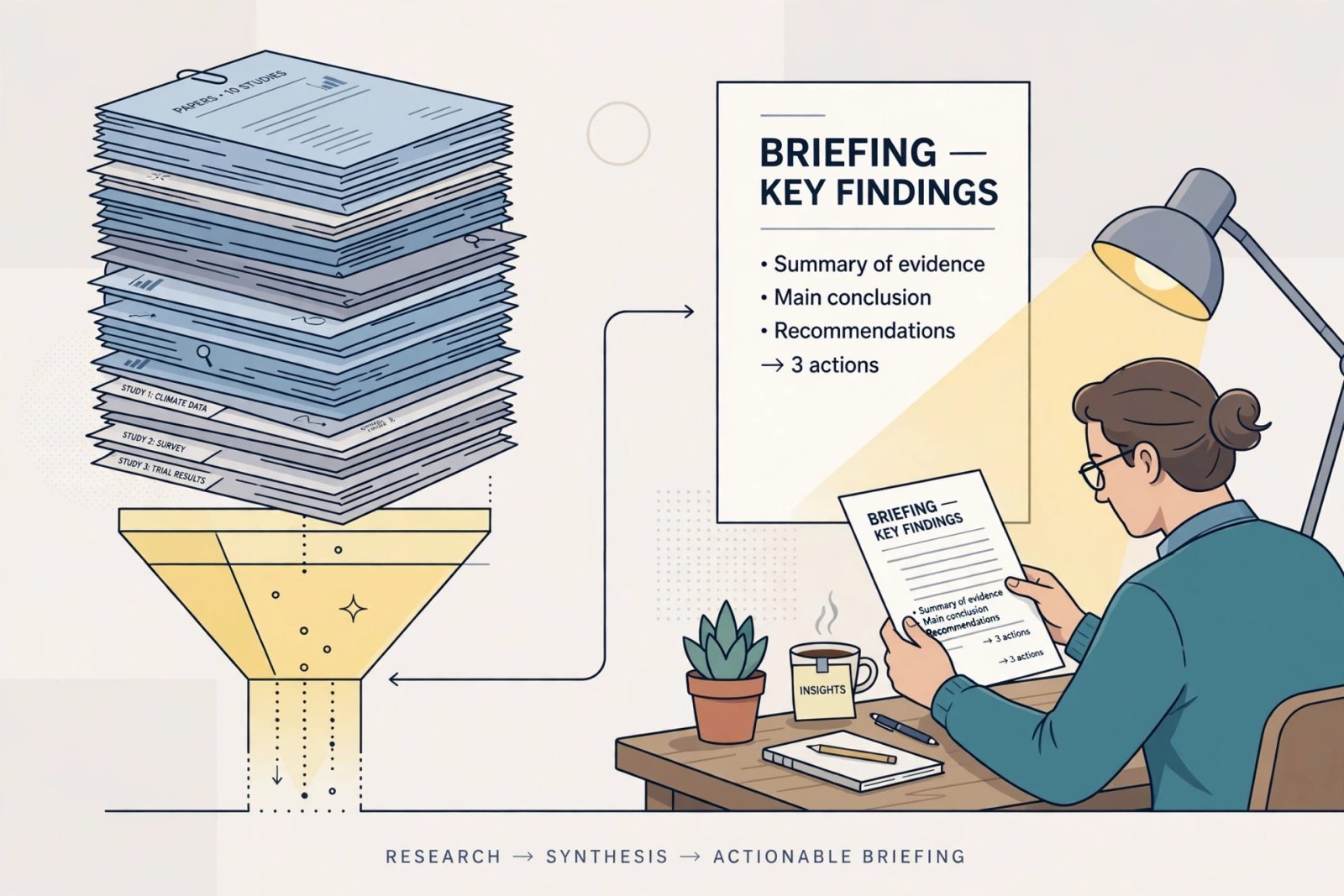
Summarize Ten Sources Into One Clear Research Brief
A structured research brief that synthesizes many sources by theme, surfaces conflicts and gaps, and ends with a next step.

Customize this prompt
Fill in the fields below — the prompt text updates automatically. [BRACKETED] words are placeholders you replace.
The prompt
You are a research analyst who turns piles of sources into decisions. My research question is: [RESEARCH_QUESTION]. Here are my sources: [SOURCE_LIST]. Write a structured research brief: a 3-sentence executive summary answering the question, a findings section grouped by theme (not by source), with each claim cited to the source it came from, a disagreements section where sources conflict and what might explain the gap, a gaps section listing what the sources do not cover, and a recommendation section: what I should do next given the evidence. Add a source table with one row per source: author/year, method, key finding, and limitation. Rules: never present a claim without a source tag, never smooth over contradictions, and mark any inference of yours as [ANALYST INFERENCE]. If a source is weak or low-quality, say so. Keep the brief under [MAX_WORDS] words excluding the table.
How to use it
- Collect your sources into [SOURCE_LIST].
- State [RESEARCH_QUESTION] in one sentence.
- Run the prompt and check every claim has a source tag.
- Read the disagreements section before trusting the summary.
- Use the gaps section to plan follow-up research.
Customization tips
Paste your sources into [SOURCE_LIST] — abstracts, notes, or full excerpts. Set [RESEARCH_QUESTION] to the one question the brief must answer.
Example use case
A student, analyst, or founder drowning in papers and articles who needs one trustworthy brief that answers a single question.
Frequently asked questions
Can I use abstracts instead of full papers?
Yes, for the synthesis step. A brief built from abstracts alone should say so, and mark every claim that needs the full text as unverified.
Should the brief follow each source in order?
Group by finding, not by paper. A brief that walks through sources one by one reads like a list; one organized by theme reads like an argument.
Share
Tags: research research brief literature review synthesis academic writing evidence writing prompts
Reviewed by the PromptVault editorial team on October 16, 2026.
Source notes: Daily pipeline 20261016 batch 10